Sunday, June 1, 2014

OLIVER! - 1968


There’s a certain peculiarity to musicals, or rather in the types of stories that undergo the conversion into a song and dance affair. In some instances, the inclusion of music makes sense. Fanny Brice became a celebrated performer on stage, establishing a natural connection to the fact that Funny Girl should be told largely through the use of music and theater. Roxie Hart dreams of being a jazz baby on the cool stage, making the musical numbers in Chicago a sensible pairing. This brings us to Oliver! (As if to make it more emphatic, the title comes garnished with an exclamation point, but like all garnishes, it just feels in the way and so I am going to set it aside for the remainder of this entry and simply refer to it as Oliver.) To me, it seems a creatively odd notion to read Charles Dickens’ bleak, mangy novel and pepper it with musical numbers. Of course, I’m no music man, nor do I scarcely read literature whilst imagining a soundtrack in my mind, especially not for a story like Oliver Twist. Unfortunately, the annexation of music into the story slightly candy-coats the film, which I think scales down some of the societal criticism and darker themes laced into Dickens’ original text. But on the whole, as a piece of energetic entertainment, Oliver works splendidly well.

Directed by the notable Sir Carol Reed (yes, he’s a dude named Carol), whose time in the director’s chair yielded other regarded films such as Odd Man Out and the noir classic The Third Man. The gang of actors toplining Oliver has sadly become a short list of names that have long since faded in the rearview mirror of the general consciousness; actors like Mark Lester, Shani Wallis, Ron Moody, Jack Wild and Oliver Reed, who, incidentally, is the director’s nephew (Is there a little nepotiz going on here?). Oliver nabbed an impressive double-digit haul of nominations with 11, pick-pocketing five statuettes, including Best Picture for 1968. It also picked up and additional, honorary Oscar for its achievements in the art of choreography. In terms of Oscar trivia, Oliver became the first, and last, G-rated film to take home the Academy’s top prize, which is a sort of a default claim to fame because none of the previous winners had received an MPAA rating at the time of their Oscar victory. It also marked the last time a musical would wind its fingers around a Best Picture Oscar, until Chicago ended the drought 34 years later.

Out of the gates, I have to admit that it’s difficult watching Oliver without comparing it to the novel. But in further considering this reaction, it doesn’t seem fair to tie up Oliver with this chord of judgment. It would be like admiring an individual, but later finding immediate disappointment with that individual’s identical twin because, although they look similar and share the same genealogy, they are ultimately two separate individuals. There is some part of human nature that wants a film to be just like its source material, but even though the two products are alike in many ways, at the end of the day they are different and should be judged on their own merits. It’s difficult to see the distinction at times, an inability which I think seeps, in a modicum, into my reaction to the film. However, in the film’s opening credit, it says the film is freely adapted from Charles Dickens’ Oliver Twist, which I appreciate as an acknowledgment that the filmmakers didn’t set out to make a cinematic replica of what Dickens had created.

On that note, I’ll start with perhaps the film’s overarching strength: its impeccable casting, which is no small accomplishment in a film with a large cast of children. The number of films with major child characters that don’t annoy the hell out of me is few and far between (every Jurassic Park film ever made, I’m looking your direction), so I have to give a tip of the (top) hat to casting director Jenia Reissar, for pulling off the difficult task of casting a reported 84 boys. Extra kudos should be given to Reissar for envisioning Jack Wild in the role of the Artful Dodger. It’s such an iconic literary character, tagging it with an enormous amount of pressure to pull it off. But Wild darts up and down the streets of London with such aplomb and ownership that he seemingly redefines the iconography of the Artful Dodger and pick pockets the novel to make the character completely his own. In my mind, it’s impossible to read Oliver Twist and not picture Wild’s be-smudged face and blue waist coat in my mind when reading the scenes with the Artful Dodger.

However, while Reissar should be commended for her keen eye in singling out Jack Wild for the role of the Artful Dodger, she should also be administered a light slap on the wrist for casting Mark Lester in the titular role. In all fairness, it’s not that he turns in an abysmal performance. It’s more that he’s so overshadowed by everyone else that gets completely lost in the shuffle, which made the character boring. It’s simply bad form to have your lead character be a snoozer. It’s even worse form to have the lead character feel so insignificant that you find yourself rooting against him. Quite frankly, I wanted Mr. Bumble to dunk him in the cauldron of gruel. In the end, insofar as Oliver was concerned, I found nothing memorable or endearing about him. Actually that’s not true; his singing voice is ridiculous. Apparently, they dubbed him over with the singing voice of a young girl, which makes Oliver even less likable because he sounds like anyone could kick his ass. Maybe all of this isn’t Lester’s fault, particularly because I think child actors tend to do as their told by the director, as opposed to acting on instinct. But still, I can’t let Lester off that easily because ultimately it’s his mug up there singing and dancing and he’s had a free ride long enough. It’s time someone called it like it is.

The grand tradition of literary villains being infinitely more interesting than their heroic counterparts held firm in Oliver, being rounded out with tremendous performances by Ron Moody as the greasy, skinny Fagin and Oliver Reed as the imposing Bill Sikes (which I’ve always been convinced was a riff on the word psycho). Moody, who was apparently only 30 years old in the film, gives a louche style to his rendition of Fagin. Even though he oils his way through every scene with a yellowed grin, he manages to be charming to the point where you find yourself rooting for him. My heart still kind of aches for Fagin when he drops his box of treasures in the mud, hopelessly grasping about in the murky depths for his boosted items. I always found it appropriate that he is seemingly roasting cocktail weenies of the fire because in a way Fagin is a little weenie, but a charismatic one, nonetheless.

If Fagin’s weasel persona is lacking any intimidating qualities, it’s more than likely due to the fact that Bill Sikes has cornered the market and amassed a monopoly of brutish character in the streets of London. It’s no understatement to say that Oliver Reed casts a shadow over the entire narrative. His presence is felt even when he’s not present, which is remarkable because he doesn’t actually have a lot of dialogue. Reed strikes all the right notes in being a mean son of a bitch that could crush your throat at any unforeseen moment. He has an imposing stature, subtle glare and demanding tension in his mouth, disinviting all humanity from attempting to approach him. What’s remarkable about Reed’s performance is that he achieves all of this without straying off into caricature territory. He balances all of the elements that makes Sikes who he is, motivated as he is, that his credibility as a villain is never jailed on suspicion of fraud. I have no doubt Reed would have a received an Oscar nomination for Best Supporting Actor, had his fellow cast mate Jack Wild not dodged into the category ahead of him.

Apart from the strong cast of players, the art and set direction of Oliver impeccably realizes Dickens’ world in all of its grimy glory. The workhouse is a wonderfully constructed canvas of drab and dreck colors. When all of the orphans come marching in to the solitary “dining” hall like prisoners, the monotone palate of grays paradoxically creates a splendid visual of living, breathing hopelessness. In equal measure, Fagin’s hideout is a wonderful apparatus of rot, teetering over a pool of feculent waste, the likes of which would most assuredly be condemned by the EPA. The repulsive nature of Fagin’s hide out is effective in keeping the music from completely turning the film into a cheery roadshow. London is as much a character in this story as any of the actors, and the sets create a cityscape devoid of soap and solace, waiting to just rip you off and leave you twisting in the gutter. The grimy backdrops hold down a reminder to the audience that this shit is real; that the world is a thorny place; and life aint no picnic for these exploited kids.

In the end, I think why I like the story of Oliver Twist, is its illustration of how the good and evil in the world struggle to influence the young souls in order to corrupt or solidify their character by setting them on a particular course. The film does a fine job in capturing this conflict portrayed in the book, which is at the core of the narrative. The sense of two sides waging battle for Oliver himself is a contest that is keenly felt, thanks in part to great gallery of rogues. There are so many interesting examples of characters in the film that show the complexities that societal influences exert in molding people into their respective natures, which contribute to one side or the other in this grand war. Nancy is clearly an individual with a functioning moral compass, but is forced into a life of thievery in order to survive. But her regrets at not having the opportunity to choose a different path; to end up a different person drive her to put everything on the line in order to save Oliver from the same fate. By wading into this battle, she pays the ultimate price, indicating the monstrous nature of the world in demanding the loyalty of its servants. Even Fagin vacillates back and forth in “reviewing the situation” of his life, contemplating whether he should get married, settle down, change. But in the end, he finds his nature so reified that he is unable to turn back around and start over again, and so scuttles off into the sunset to continue his five-finger discounted ways. Through these characters, Dickens holds a mirror up to show the terrible effects society has on a large population of its members. This idea is most certainly not lost in translation, even though the tune of its presentation comes with some alterations.

Favorite Line: Oliver’s benefactor Mr. Brownlow summons Mr. Bumble to his home to discuss the boy’s parentage. Upon finding out that Mrs. Bumble had been harboring evidence as to the Oliver’s family, Mr. Brownlow scolds the pair of them in a particularly amusing exchange.  

Mr. Brownlow: In the eyes of the law, you are the more guilty of the two, for the law supposes that your wife acts under your direction.
Mr. Bumble: If that's what the law supposes, sir, then the law is an ass! If that be the eyes of the law, sir, then the law is a bachelor!

Thursday, May 29, 2014

IN THE HEAT OF THE NIGHT - 1967


In comparison to its Best Picture colleagues of the 1960s, In the Heat of the Night stands out as a pronounced departure from the musicals and historical epics that so dominated the decade. A topical film told with edge and grit, In the Heat of the Night feels like a page ripped from the diary of its time and plastered up on screen. Despite a twangy soundtrack and some dated dialogue, time has not blunted the film’s taut, suspenseful qualities. Nor has its message of tolerance and respect lost any of its sizzle. Several reasons account for this preservation: characters that matter, electrifying lead performances and an outspoken, truthful depiction of race relations that, refreshingly, doesn’t feel motivated to make any type of a political point. But above all, a great line also improves a film’s chances of retaining memorability, and “They call me Mister Tibbs!” is about as good as it gets, old sport.  

Directed by famed Canadian director Norman Jewison, whose resume includes Fiddler on the Roof and Moonstruck, as well as some Doris Day flicks, In the Heat of the Night marked his first inclusion into Oscar’s Best Director category. The film’s cast is led by top-drawer talent Sidney Poitier and Rod Steiger in two career defining performances. Of the two, Steiger arguably has the flashier role, which I think is why he went on to net so many accolades for this role, including the Oscar for Best Actor. What’s strange, outrageous even, is that Poitier’s name was left completely off the short list of Best Actor nominees, especially in light of his strong supporting work that same year in Guess Who’s Coming to Dinner? I would contend that without Poitier’s formidable presence matching Steiger’s swagger, the latter’s performance would not have been as deftly realized. Its years like this that makes it a shame the Academy doesn’t buck its own rules from time to time and award two Oscars for the same category. 

Based on John Ball’s novel of the same name, In the Heat of the Night is a dramatic mystery yarn marbled with murder, racism and a myriad of false accusations and red herrings. Set in the festering town of Sparta, Mississippi, In the Heat of the Night follows Virgil Tibbs, a black Philadelphia police detective passing through town. While waiting for his train, Tibbs is picked up on false charges for the murder of Mr. Colbert, a white wealthy Chicago industrialist angling to construct a factory in Sparta. After his police credentials check out, the charges against Tibbs are quickly dropped. But feeling the heat after Colbert’s widow threatens to pack up the factory and leave town unless the murderer is found, police Chief Bill Gillespie enlists Tibbs’ help in cracking the case. 

Boiled down to its core, In the Heat of the Night is essentially a whodunit. But what makes it intriguing is that it’s more of a who-cares-whodunit. As an audience, you never meet Mr. Colbert; therefore no emotional investment is ever transacted into this guy. The fact that he’s been bludgeoned on the head only conjures up a fleeting interest in him at best. Snooze right? In all honesty, who really cares who murdered this random person? The film’s true suspense and tension is rooted in the question of whether or not Tibbs and Gillespie will be able to turn a blind eye to their differences and solve this case. Despite his prejudiced attitude towards Tibbs, it’s clear that Gillespie’s nature in this regard is more a product of his environment than a deeply nurtured belief. At heart, he’s a good man who comes to respect and admire Tibbs, despite the periodic emergence of backward thinking. On the other hand, Tibbs is, and rightfully so, a proud, accomplished individual who knows he is heads and tails above any of the doofuses on the Sparta police force when it comes to detective finesse. But the question still looms: Will Tibbs suffer the local yokels in the name of pursuing justice?

As mentioned, Steiger’s police chief Gillespie is the showier part in comparison to Tibbs, and Steiger owns it with complete aplomb. The situation forces Gillespie to have his feet firmly planted on two sides of the racial barrier, which draws out his character in surprising and intriguing ways. Gillespie has to assume a variety of versions of himself from being a diplomat to a referee to a hard-ass police chief all without undermining his own credibility in the eyes of the town. But the scene that hits it home is when Tibbs is at Gillespie’s house and Gillespie exhibits a degree of vulnerability by opening up about his failed marriage and other shortcomings. It adds such an effective dimension to this type of character in a way that is so rarely executed on screen. It’s a high-wire act that could have turned to ash in lesser hands, but Steiger is aces at maneuvering through the complexities in a way that is utterly convincing, old sport.

But as in every buddy cop scenario, the flashier personality depends on a no-nonsense partner to counter his presence and keep the situation steadily on the rails. In this case Sidney Poitier has a tall order to fill, but he proves more than capable of the challenge. Whenever I think of Sidney Poitier, I always think of someone who carries himself with class and dignity, no matter what injustices may be swirling around him. In the Heat of the Night is perhaps one of the strongest examples from his career that allows him to exhibit his abilities of portraying a character of stature and substance. By far the most memorable moment of Poitier’s performance in this film is during a scene when Tibbs is questioning a wealthy, wrinkling plantation owner named Endicott who publicly opposed the murder victim’s intentions to build a factory in town, making him a possible suspect. The series of questions from a black man roils Endicott’s annoyance, causing a splenetic outburst that leads him to slap Tibbs. Without skipping a beat, Tibbs bitch slaps him right back, screeching the proverbial record to a terrifying halt, as the two stare at each other wondering what the hell happens next. The scene surges over with intensity in that moment, creating great a representation of Poitier’s career creed of not letting anyone hang their shit on him, while simultaneously being classy in the process. 

The other performance that I think merits some shine is that of Quentin Dean, who plays a teenage temptress named Delores Purdy whose sexual escapades inadvertently wind up the film’s scenario and letting it go like some toy race car. Dean really only has one scene in the film to speak of, but she is a tornado in the few minutes allotted to her, blowing everyone else off the screen as she skulks and sneers her way through a forced confession of her trampy behavior to Gillespie and Tibbs. In his review of In the Heat of the Night, famed New York Times critic Bosley Crowther referred to Dean’s character as a “slippery little slut,” which I think he absolutely meant as a compliment. Dean basically disappeared from the showbiz landscape after In the Heat of the Night, which is too bad because she got things off to such a promising start. And she ends up being one of the many surprises that make In the Heat of the Night sizzle with suspense and suspicions.

Favorite Line: I know this is unoriginal of me, but “They call me Mister Tibbs!” is just too classic to overlook as a selection for my favorite line in this film. It’s not so much the line itself, but it’s the way Sidney Poitier rolls up the thunder from his belly and releases the words with such striking force. Anyone watching this film wearing a toupee is likely to have it blown right off their noggin when that line reverberates through the speakers.

Tuesday, May 27, 2014

A MAN FOR ALL SEASONS - 1966


I’ve seen a lot of films in my day, which means that I’ve sat through a lot of great films and a lot of crappy ones (Nacho Libre I’m looking in your direction). So it’s always a pleasant surprise to feel like you can still discover a film that falls into the former category, and so it was for me with A Man for All Seasons. I knew nothing about this film prior to watching it, but came away impressed most of all with its steadfast rendering of the topic of faith and conviction with such thoughtful depth. On this point, the film felt fresh and bold, as there aren’t many films then or today that can match it in the arena of intellectual vigor, particularly where Christian beliefs are concerned.
   
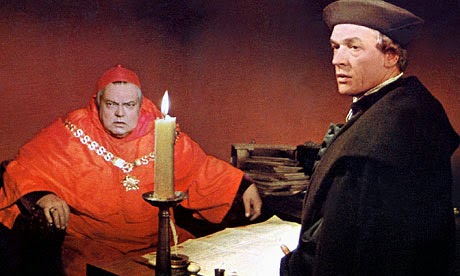
Directed by the versatile Fred Zinnemann, who first clutched Oscar gold for From Here to Eternity, A Man for All Seasons boasts a cast of distinguished British players, namely Paul Schofield, Dame Wendy Hiller, Robert Shaw and Susannah York. Added into this mix for good fun is Orson Welles, an American legend who makes an extended, unforgettable cameo, due to his talents as an actor, but also because he looks like he swallowed a hot air balloon. The Academy knighted the film with five Oscars, including Best Picture for 1966; a victory with a hint of upset over its juggernaut competition in the form of Who’s Afraid of Virginia Woolf? 

While there are many things to admire in A Man for All Seasons, to me the two most salient elements are the performances and the script. Adapted from Robert Bolt’s play of the same name, A Man for All Seasons recounts the final period of Sir Thomas More, a well-respected Lord Chancellor during the reign of King Henry the VIII in the early 16th century. The film examines the anchored depths of More’s conscience as he finds himself at loggerheads with the King when he refuses to forego his religious convictions in favor of sanctioning Henry’s divorce from Catherine of Aragon, an act forbidden by the Catholic Church at that time. The King’s rich-kid petulance over this snub opens the door for More’s political rivals to yoke him to corrupt charges of treason, ultimately sending him to his death.    

In a sense, the screenplay is the true star of the film, akin to the manner in which the screenplay is the star of Pulp Fiction. The script muses on and illustrates the interconnecting properties of faith, the rule of law and the trappings of virtues sold for profit, among other philosophical points. What’s remarkable is that the dialogue unites the conceptual equivalent of cats and dogs, managing to be both scholarly and entertaining. For anyone who’s ever done a master’s degree in political science knows that scholarly and entertaining are thoroughly divorced from one another.

Among the many noteworthy sequences of dialogue, there are many kernels embedded in the exchange between More and the Cardinal Wolsey, who vainly attempts to persuade him to give a thumbs up to the divorce so that the King can marry Anne Boleyn.  

Cardinal Wolsey: That... thing out there; at least she's fertile.
Sir Thomas More: She's not his wife.
Cardinal Wolsey: No, Catherine's his wife and she's barren as a brick; are you going to pray for a miracle?
Sir Thomas More: There are precedents.

Obviously, wonderful conversations like these require the abilities of capable actors to unlock their wit and wisdom. Everyone in A Man for All Seasons is truly equal to the task, even Vanessa Redgrave, who, as Anne Boleyn, does nothing but make eyes at Henry VIII. Everyone inhabits their roles so precisely that the story’s events elicit genuine admiration, frustration and ultimately rage at the injustices wielded about. Paul Schofield is nothing if not commendable as Sir Thomas More. It’s a role that would seem to tempt actors to tread heavily into noble and passionate gestures and tones. But Schofield tethers his performance to the virtues of restraint, expressing More’s convictions like a mountain: quiet, majestic, yet immovable.

John Hurt also gives a standout performance as Richard Rich; a nebbish, rat-faced acquaintance of More’s who scuttles around his ankles, begging him for a position in the King’s Court. The antithesis of principle, Rich eventually sells out to aid the forces conspiring to bring More down in exchange for an appointment at court. Hurt perfectly embodies the insecure man with a storefront stocked full of virtues ready to be sold to anyone for the right price. His trembling manner and anxious expression imbue him with rodent-like characteristics that make the final courtroom scene an unforgettable moment when Rich quivers in bearing false testimony against More.

If there is one complaint worth registering against the film, it’s that visibly it felt too sensible and plain, which is disappointing from a director like Zinnemann. I suppose it’s due to the fact that it’s based on a theatrical work, but in several stretches the film felt like a recorded play on stage. Snooze. It’s exciting and energetic to experience live theater, sure, but it can be downright dull to watch theater on film. It drags and can be uninspiring. At times, A Man for All Seasons comes perilously close to putting its foot in those traps. It doesn’t use space effectively. The power and potential effects of editing are reduced to a minimum. Scenery is underutilized to foment any shock and awe. It feels largely unimaginative; eschewing the freedoms that a film adaptation can offer in so many areas that a confined stage can’t.

But the fact that A Man for All Seasons has the drab look of an old BBC production and can still retain electricity and wit is a testament to the films overall strength. It's not going to be put into a corner. But if you can forgive the film of it visual shortcomings, it’s a rewarding cinematic experience, one that you’re not likely to find among new releases today, given the indifference and/or hostility toward telling stories of men of great faith and courage. (And no, the current version of Noah doesn’t count).

Favorite Line: When More denies Rich’s request to help him secure a position in court, More suggests an different profession for him altogether, while simultaneously teaching him a lesson in the importance of perspective. 

Sir Thomas More: Why not be a teacher? You'd be a fine teacher; perhaps a great one.
Richard Rich: If I was, who would know it?
Sir Thomas More: you; your pupils; your friends; God. Not a bad public, that.

Sunday, May 11, 2014

THE SOUND OF MUSIC - 1965


After perusing through a stack of past reviews, I got the sense that in some smaller critical corners it was quite the fashion to lower one’s knickers and dump all over The Sound of Music. Why? What are the charges, you may be asking yourself? Well, they can quite summarily be articulated for reasons of being overly saccharine and sentimental; merrily out of touch with the reality going on around it. Of course the critics who jaw on about The Sound of Music being too cheerful and such have clearly found themselves on the wrong side of history and can go soak their heads. (Legend has it that her negative review led to Pauline Kael’s dismal from McCall’s magazine). It seems pointless to come to the defense of this excellent film, as it is obviously capable of standing on its own two feet. But I feel I must at least answer the charges that this film stands as an example of maudlin movie making. What rubbish. First of all, it’s a musical, which is a genre that traditionally comes coated in extra emotion, whether dower or delightful. If you want depressing drama, go rent Sophie’s Choice. To my next point, I pose the question: What is so wrong with a film that emanates sunshine, anyway? Where does the inherent atrocity lay in presenting a story that is uplifting, however sweet? Look, I’m not saying I fawn all over cinematic works that are served up with a dollop of sprinkles and a cherry on top. But I have no problem with them, as long as they own it. And The Sound of Music does. It is unquestionably authentic in its tone and demeanor. I declare the whole endeavor to be free from even a hint of irony. At its core, The Sound of Music espouses the idea that music can be a force of good in people’s lives; being a conduit that can deliver happiness, soften a hard heart and bring people together. Anyone who is at all culturally literate knows this about the reality of music, which makes it ridiculous to besmirch a musical that endeavors to highlight this truth. 

Directed by the keenly proficient Robert Wise, who previously sat in the director’s chair on West Side Story, and starring the unsinkable Julie Andrews and the stoic Christopher Plummer, The Sound of Music created beautiful music to the tune of 10 Academy Award nominations. The film would ultimately waltz away with five wins, including everyone’s favorite thing: the Oscar for Best Picture in 1965. In terms of Oscar trivia, The Sound of Music was the first film since Hamlet to win Best Picture without receiving a nomination in the screenplay category. It would hold this distinction until 1997, when Titanic would relieve it of the dubious, albeit minor, honor. The smashing success couldn’t have come at a better time for 20th Century Fox, as The Sound of Music is credited with pulling back the studio from the brink of financial ruin after the loosed incurred by the absurdly over-produced Cleopatra. 

Anyone who has made even a tenuous effort to be culturally engaging throughout their life should be familiar with The Sound of Music’s plot. If not, then make a u-turn, find a copy of the film and get with the program. You won’t regret it. It’s sincerely one of those films that can be watched multiple times without going stale. However, it’s difficult to flesh out the underlying reason owing to the film’s watchability factor. But if there’s a gun to my head, I would probably fess up to it being the radiance of Julie Andrews’ performance. She’s like Michael Jordan, where she elevates the rest of the cast’s game, drawing out talent that they would otherwise not be capable of producing. Every musical number, every line of dialogue and every scene is better when she is singing it, saying it or acting in it. Julie Andrews is so effortless as Maria that I think it becomes easy to overlook the multiple elements that she has to knit together. The role is a cocktail of insecurity, precociousness, tenderness, comedy, romance and inner strength, among other traits, and Andrews threads each one seamlessly. On top of that, she carries the evolution of Maria in a subtle manner that by the film’s end she has morphed into a completely different being from who she was twirling around the Austrian Alps at the beginning. I know the performance is a beloved one, but I think in some ways it’s an underrated one. It’s a role that I think could have easily been turned into something more over the top, resembling caricature instead of a genuine person. The urge to go overboard instead of keeping it grounded must have been difficult to resist, but Andrews always moors Maria to the ground, no matter how silly the situation may be.


There is a degree of boldness to naming a film The Sound of Music because it implies that it is going to be a
film with good music. If it doesn’t deliver on its own inherent confidence, then it runs a grave risk of looking somewhat ridiculous. It’s like nicknaming yourself The Painter, and then not having any artistic skill. But The Sound of Music has every right to swagger in this department because the soundtrack is a hit parade of classics. There really isn’t a dud in the bunch, although I’ll admit that I do have a hard time sitting through the Reverend Mother’s rendition of Climb Ev’ry Mountain. It’s one of those rare musicals where every song is strong and executed with an irresistibly entertaining sense of panache that I almost prefer the musical numbers to the scenes of spoken dialogue. I think the strength of the musical numbers is reflected in the accompanying choreography, which is fairly simple and straightforward, leaving much of the heavy lifting to the music itself. The numbers aren’t choreographed with glitz and sex appeal like Chicago, nor do they possess a grandeur and elegance like Hello Dolly. They have a minimal, yet unforgettable style about them that is enduring because of the music.

For the sake of full disclosure, I have to confess that I have two a personal connections to The Sound of Music, causing it to forever reserve real estate within my heart. The first relates to my time as intern in Washington, DC many years ago with USA TODAY. I was busy wrapping up another internship with the New York Daily News when I got an offer from USA TODAY to come work for them for the remainder of the summer. Of course I said yes, but that left me scrambling to find a place to stay in a city that I didn't know and where I wasn't acquainted with a soul. Out of sheer desperation, I elected to rent a room from this couple. They were a quirky and unique pair, but nonetheless nice enough people to rent from for a two months. However, at night they ramped up the air conditioning and turned the whole house into a veritable meat locker. The first few nights, I was freezing my face off, but I avoided asking to borrow additional blankets from my landlords because I felt that it was probably best to limit my interactions with them.

But by the third night it had become too much. I was nodding off at work from the lack of sleep at home, due to the arctic atmosphere. So I sat up on the edge of my bed in an attempt to devise a solution. I remember looking over at the curtains on my windows, which were these gray, heavy, hideous deep corduroy shrines to bad taste. But as I sat there contemplating their repulsive nature, the song My Favorite Things began churning in my mind, inspiring me to take them down for blankets, in a move similar to Maria's sense of ingenuity of recycling her old drapes to make play clothes for the von Trapp children. I'm happy to report that night marked the end of chilly slumber.

My second connection to The Sound of Music is to the song Sixteen Going on Seventeen. It was my audition number when I tried out for a play in high school. I had never done any type of theater before, nor do I possess much of a singing voice. But I recall practicing the hell out of that song, singing it in the shower, in the car on the way to school and just about anywhere else that I might find myself alone. I’m not trying to convey false modesty by stating that singing was not my forte, nor was it something I had devoted much time and attention to. But the fact that I could pull it off and sing it well enough speaks to another quality about the songs in The Sound of Music: accessibility. Most of them are relatively easy for the masses to sing, giving them an everyday sort of appeal. I guess another way to say it is that they’re just a lot of fun, plain and simple. There is no way you’re not humming the puppet show song without it upturning the corners of your mouth.

However, the moment of the film that really made me smile are those bad-ass nuns at the end who rip off the engine parts of the Nazi’s automobiles so that they won’t function and the von Trapp’s can make their clean getaway. I remember as a kid always enjoying this tiny, but pivotal scene. I think, in large part, its appeal rested in the fact that no one, not even the Nazis, would suspect nuns to be capable of pulling off such a cheeky move. I love the fact that they exploited this underestimation of their nature to save the day and contribute to The Sound of Music being one damn happy film. (So there Pauline Kael!)

Favorite Line: When Maria first meets Captain von Trapp, I always thought this little exchange about Maria’s dress was amusing. 

Captain von Trapp: It's the dress. You'll have to put on another one before you meet the children.
Maria: But I don't have another one. When we entered the abbey our worldly clothes were given to the poor.
Captain von Trapp: What about this one?
Maria: The poor didn't want this one. 

Who are these poor people that they can afford to have such high-minded sartorial tastes?