Tuesday, May 27, 2014

A MAN FOR ALL SEASONS - 1966


I’ve seen a lot of films in my day, which means that I’ve sat through a lot of great films and a lot of crappy ones (Nacho Libre I’m looking in your direction). So it’s always a pleasant surprise to feel like you can still discover a film that falls into the former category, and so it was for me with A Man for All Seasons. I knew nothing about this film prior to watching it, but came away impressed most of all with its steadfast rendering of the topic of faith and conviction with such thoughtful depth. On this point, the film felt fresh and bold, as there aren’t many films then or today that can match it in the arena of intellectual vigor, particularly where Christian beliefs are concerned.
   
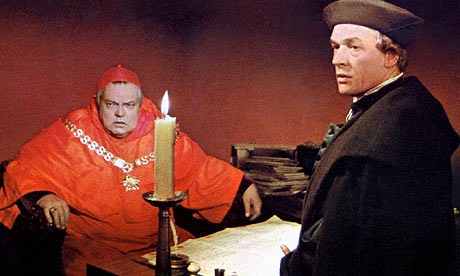
Directed by the versatile Fred Zinnemann, who first clutched Oscar gold for From Here to Eternity, A Man for All Seasons boasts a cast of distinguished British players, namely Paul Schofield, Dame Wendy Hiller, Robert Shaw and Susannah York. Added into this mix for good fun is Orson Welles, an American legend who makes an extended, unforgettable cameo, due to his talents as an actor, but also because he looks like he swallowed a hot air balloon. The Academy knighted the film with five Oscars, including Best Picture for 1966; a victory with a hint of upset over its juggernaut competition in the form of Who’s Afraid of Virginia Woolf? 

While there are many things to admire in A Man for All Seasons, to me the two most salient elements are the performances and the script. Adapted from Robert Bolt’s play of the same name, A Man for All Seasons recounts the final period of Sir Thomas More, a well-respected Lord Chancellor during the reign of King Henry the VIII in the early 16th century. The film examines the anchored depths of More’s conscience as he finds himself at loggerheads with the King when he refuses to forego his religious convictions in favor of sanctioning Henry’s divorce from Catherine of Aragon, an act forbidden by the Catholic Church at that time. The King’s rich-kid petulance over this snub opens the door for More’s political rivals to yoke him to corrupt charges of treason, ultimately sending him to his death.    
In a sense, the screenplay is the true star of the film, akin to the manner in which the screenplay is the star of Pulp Fiction. The script muses on and illustrates the interconnecting properties of faith, the rule of law and the trappings of virtues sold for profit, among other philosophical points. What’s remarkable is that the dialogue unites the conceptual equivalent of cats and dogs, managing to be both scholarly and entertaining. For anyone who’s ever done a master’s degree in political science knows that scholarly and entertaining are thoroughly divorced from one another.

Among the many noteworthy sequences of dialogue, there are many kernels embedded in the exchange between More and the Cardinal Wolsey, who vainly attempts to persuade him to give a thumbs up to the divorce so that the King can marry Anne Boleyn.  

Cardinal Wolsey: That... thing out there; at least she's fertile.
Sir Thomas More: She's not his wife.
Cardinal Wolsey: No, Catherine's his wife and she's barren as a brick; are you going to pray for a miracle?
Sir Thomas More: There are precedents.

Obviously, wonderful conversations like these require the abilities of capable actors to unlock their wit and wisdom. Everyone in A Man for All Seasons is truly equal to the task, even Vanessa Redgrave, who, as Anne Boleyn, does nothing but make eyes at Henry VIII. Everyone inhabits their roles so precisely that the story’s events elicit genuine admiration, frustration and ultimately rage at the injustices wielded about. Paul Schofield is nothing if not commendable as Sir Thomas More. It’s a role that would seem to tempt actors to tread heavily into noble and passionate gestures and tones. But Schofield tethers his performance to the virtues of restraint, expressing More’s convictions like a mountain: quiet, majestic, yet immovable.

John Hurt also gives a standout performance as Richard Rich; a nebbish, rat-faced acquaintance of More’s who scuttles around his ankles, begging him for a position in the King’s Court. The antithesis of principle, Rich eventually sells out to aid the forces conspiring to bring More down in exchange for an appointment at court. Hurt perfectly embodies the insecure man with a storefront stocked full of virtues ready to be sold to anyone for the right price. His trembling manner and anxious expression imbue him with rodent-like characteristics that make the final courtroom scene an unforgettable moment when Rich quivers in bearing false testimony against More.

If there is one complaint worth registering against the film, it’s that visibly it felt too sensible and plain, which is disappointing from a director like Zinnemann. I suppose it’s due to the fact that it’s based on a theatrical work, but in several stretches the film felt like a recorded play on stage. Snooze. It’s exciting and energetic to experience live theater, sure, but it can be downright dull to watch theater on film. It drags and can be uninspiring. At times, A Man for All Seasons comes perilously close to putting its foot in those traps. It doesn’t use space effectively. The power and potential effects of editing are reduced to a minimum. Scenery is underutilized to foment any shock and awe. It feels largely unimaginative; eschewing the freedoms that a film adaptation can offer in so many areas that a confined stage can’t.

But the fact that A Man for All Seasons has the drab look of an old BBC production and can still retain electricity and wit is a testament to the films overall strength. It's not going to be put into a corner. But if you can forgive the film of it visual shortcomings, it’s a rewarding cinematic experience, one that you’re not likely to find among new releases today, given the indifference and/or hostility toward telling stories of men of great faith and courage. (And no, the current version of Noah doesn’t count).

Favorite Line: When More denies Rich’s request to help him secure a position in court, More suggests an different profession for him altogether, while simultaneously teaching him a lesson in the importance of perspective. 

Sir Thomas More: Why not be a teacher? You'd be a fine teacher; perhaps a great one.
Richard Rich: If I was, who would know it?
Sir Thomas More: you; your pupils; your friends; God. Not a bad public, that.

Sunday, May 11, 2014

THE SOUND OF MUSIC - 1965


After perusing through a stack of past reviews, I got the sense that in some smaller critical corners it was quite the fashion to lower one’s knickers and dump all over The Sound of Music. Why? What are the charges, you may be asking yourself? Well, they can quite summarily be articulated for reasons of being overly saccharine and sentimental; merrily out of touch with the reality going on around it. Of course the critics who jaw on about The Sound of Music being too cheerful and such have clearly found themselves on the wrong side of history and can go soak their heads. (Legend has it that her negative review led to Pauline Kael’s dismal from McCall’s magazine). It seems pointless to come to the defense of this excellent film, as it is obviously capable of standing on its own two feet. But I feel I must at least answer the charges that this film stands as an example of maudlin movie making. What rubbish. First of all, it’s a musical, which is a genre that traditionally comes coated in extra emotion, whether dower or delightful. If you want depressing drama, go rent Sophie’s Choice. To my next point, I pose the question: What is so wrong with a film that emanates sunshine, anyway? Where does the inherent atrocity lay in presenting a story that is uplifting, however sweet? Look, I’m not saying I fawn all over cinematic works that are served up with a dollop of sprinkles and a cherry on top. But I have no problem with them, as long as they own it. And The Sound of Music does. It is unquestionably authentic in its tone and demeanor. I declare the whole endeavor to be free from even a hint of irony. At its core, The Sound of Music espouses the idea that music can be a force of good in people’s lives; being a conduit that can deliver happiness, soften a hard heart and bring people together. Anyone who is at all culturally literate knows this about the reality of music, which makes it ridiculous to besmirch a musical that endeavors to highlight this truth. 

Directed by the keenly proficient Robert Wise, who previously sat in the director’s chair on West Side Story, and starring the unsinkable Julie Andrews and the stoic Christopher Plummer, The Sound of Music created beautiful music to the tune of 10 Academy Award nominations. The film would ultimately waltz away with five wins, including everyone’s favorite thing: the Oscar for Best Picture in 1965. In terms of Oscar trivia, The Sound of Music was the first film since Hamlet to win Best Picture without receiving a nomination in the screenplay category. It would hold this distinction until 1997, when Titanic would relieve it of the dubious, albeit minor, honor. The smashing success couldn’t have come at a better time for 20th Century Fox, as The Sound of Music is credited with pulling back the studio from the brink of financial ruin after the loosed incurred by the absurdly over-produced Cleopatra. 

Anyone who has made even a tenuous effort to be culturally engaging throughout their life should be familiar with The Sound of Music’s plot. If not, then make a u-turn, find a copy of the film and get with the program. You won’t regret it. It’s sincerely one of those films that can be watched multiple times without going stale. However, it’s difficult to flesh out the underlying reason owing to the film’s watchability factor. But if there’s a gun to my head, I would probably fess up to it being the radiance of Julie Andrews’ performance. She’s like Michael Jordan, where she elevates the rest of the cast’s game, drawing out talent that they would otherwise not be capable of producing. Every musical number, every line of dialogue and every scene is better when she is singing it, saying it or acting in it. Julie Andrews is so effortless as Maria that I think it becomes easy to overlook the multiple elements that she has to knit together. The role is a cocktail of insecurity, precociousness, tenderness, comedy, romance and inner strength, among other traits, and Andrews threads each one seamlessly. On top of that, she carries the evolution of Maria in a subtle manner that by the film’s end she has morphed into a completely different being from who she was twirling around the Austrian Alps at the beginning. I know the performance is a beloved one, but I think in some ways it’s an underrated one. It’s a role that I think could have easily been turned into something more over the top, resembling caricature instead of a genuine person. The urge to go overboard instead of keeping it grounded must have been difficult to resist, but Andrews always moors Maria to the ground, no matter how silly the situation may be.


There is a degree of boldness to naming a film The Sound of Music because it implies that it is going to be a
film with good music. If it doesn’t deliver on its own inherent confidence, then it runs a grave risk of looking somewhat ridiculous. It’s like nicknaming yourself The Painter, and then not having any artistic skill. But The Sound of Music has every right to swagger in this department because the soundtrack is a hit parade of classics. There really isn’t a dud in the bunch, although I’ll admit that I do have a hard time sitting through the Reverend Mother’s rendition of Climb Ev’ry Mountain. It’s one of those rare musicals where every song is strong and executed with an irresistibly entertaining sense of panache that I almost prefer the musical numbers to the scenes of spoken dialogue. I think the strength of the musical numbers is reflected in the accompanying choreography, which is fairly simple and straightforward, leaving much of the heavy lifting to the music itself. The numbers aren’t choreographed with glitz and sex appeal like Chicago, nor do they possess a grandeur and elegance like Hello Dolly. They have a minimal, yet unforgettable style about them that is enduring because of the music.

For the sake of full disclosure, I have to confess that I have two a personal connections to The Sound of Music, causing it to forever reserve real estate within my heart. The first relates to my time as intern in Washington, DC many years ago with USA TODAY. I was busy wrapping up another internship with the New York Daily News when I got an offer from USA TODAY to come work for them for the remainder of the summer. Of course I said yes, but that left me scrambling to find a place to stay in a city that I didn't know and where I wasn't acquainted with a soul. Out of sheer desperation, I elected to rent a room from this couple. They were a quirky and unique pair, but nonetheless nice enough people to rent from for a two months. However, at night they ramped up the air conditioning and turned the whole house into a veritable meat locker. The first few nights, I was freezing my face off, but I avoided asking to borrow additional blankets from my landlords because I felt that it was probably best to limit my interactions with them.

But by the third night it had become too much. I was nodding off at work from the lack of sleep at home, due to the arctic atmosphere. So I sat up on the edge of my bed in an attempt to devise a solution. I remember looking over at the curtains on my windows, which were these gray, heavy, hideous deep corduroy shrines to bad taste. But as I sat there contemplating their repulsive nature, the song My Favorite Things began churning in my mind, inspiring me to take them down for blankets, in a move similar to Maria's sense of ingenuity of recycling her old drapes to make play clothes for the von Trapp children. I'm happy to report that night marked the end of chilly slumber.

My second connection to The Sound of Music is to the song Sixteen Going on Seventeen. It was my audition number when I tried out for a play in high school. I had never done any type of theater before, nor do I possess much of a singing voice. But I recall practicing the hell out of that song, singing it in the shower, in the car on the way to school and just about anywhere else that I might find myself alone. I’m not trying to convey false modesty by stating that singing was not my forte, nor was it something I had devoted much time and attention to. But the fact that I could pull it off and sing it well enough speaks to another quality about the songs in The Sound of Music: accessibility. Most of them are relatively easy for the masses to sing, giving them an everyday sort of appeal. I guess another way to say it is that they’re just a lot of fun, plain and simple. There is no way you’re not humming the puppet show song without it upturning the corners of your mouth.

However, the moment of the film that really made me smile are those bad-ass nuns at the end who rip off the engine parts of the Nazi’s automobiles so that they won’t function and the von Trapp’s can make their clean getaway. I remember as a kid always enjoying this tiny, but pivotal scene. I think, in large part, its appeal rested in the fact that no one, not even the Nazis, would suspect nuns to be capable of pulling off such a cheeky move. I love the fact that they exploited this underestimation of their nature to save the day and contribute to The Sound of Music being one damn happy film. (So there Pauline Kael!)

Favorite Line: When Maria first meets Captain von Trapp, I always thought this little exchange about Maria’s dress was amusing. 

Captain von Trapp: It's the dress. You'll have to put on another one before you meet the children.
Maria: But I don't have another one. When we entered the abbey our worldly clothes were given to the poor.
Captain von Trapp: What about this one?
Maria: The poor didn't want this one. 

Who are these poor people that they can afford to have such high-minded sartorial tastes?


MY FAIR LADY - 1964


In refined jargon more becoming of Eliza Dolittle at the denouement of her development, My Fair Lady might aptly be limned as an elegant critique on the British class system, delivered with ticklish wit and subtle romance. In a crass outburst more likely to usher forth from Eliza the squashed cabbage leaf, My Fair Lady could succinctly be summed up as one hell of a movie that kicks ass baby!! It’s been years since I last watched My Fair Lady, and I’m pleased to report that time has done nothing to alter it of its charm and sparkling energy. The opening scene where Freddy carelessly collides with Eliza, sending her basket of violets sailing into the street, instantly teases out a smile that never takes an intermission throughout the entire film. I don’t hesitate to say that it’s a flawless cinematic work. This may be an overstatement to say about anything, let alone My Fair Lady, but the devil may care! I’m going to say it and stand by my words, old sport. Any blemishes that may besmirch this film are of such a minor classification that they are completely outshined by the sheer level of enjoyment this film delivers; akin to a tempting tray of chocolates.

Directed by the brilliant George Cukor, the original director of Gone with the Wind before being replaced by Victor Fleming, My Fair Lady is toplined by the irresistible Rex Harrison and the intoxicating Audrey Hepburn, with supporting turns by Stanley Holloway, Wilfrid Hyde-White and Gladys Cooper. The film walloped the Academy upside the head for 12 nominations, eventually dancing all night to the tune of eight victories, including Best Picture in 1964. In perhaps one of the biggest, if not bitchiest, snubs ever recorded in the ledgers of the Oscar’s history was the omission of a Best Actress nomination for Audrey Hepburn. Many attribute this neglect to the fact that Hepburn famously didn’t do her own singing in the film. Another reason often brought up in connection to this nasty oversight is the fact that Hepburn was awarded the role of Eliza Doolittle over Julie Andrews, who had originated the part on stage. Both irony and fate seemed twain to meet on the night of the Oscars when Julie Andrews went on to win the Oscar for Best Actress in Mary Poppins. I don’t begrudge the outcome of the category in Andrews’ favor because MP is a great role. It really is, and she played it to spit-spotty perfection. But that doesn’t excuse the lack of a nomination for Hepburn, who acted her ladylike ass off in My Fair Lady. Seriously, in my opinion she hasn’t turned in a more character-driven performance in her career. The decision to have her voice dubbed over for the musical numbers was the studio’s decision, not Hepburn’s, which makes it even more frustrating that she was seemingly punished by having a nomination withheld. It’s not as though she is the first actress to have her singing dubbed for her. In fact, Marni Nixon, who provided the vocals for Hepburn, did the same for Natalie Wood in West Side Story and Deborah Kerr in The King and I, for which Kerr received a Best Actress nomination. Love DK, but come on?! There is no way the quality of Hepburn’s work was even a smidgen less than Kerr’s performance alongside Yul. It just wasn’t.

Anyway, I supposed I’ve griped long enough on that point. To move one, at this point in my reviews, I usually recap the film’s plot. But in his review of My Fair Lady, Roger Ebert delivered a Henry Higgins-esque summation, writing that “it is unnecessary to summarize the plot or list the songs; if you are not familiar with both, you are culturally illiterate, although in six months I could pass you off as a critic at Cannes, or even a clerk in a good video store, which requires better taste.” I concur Roger, well said. If you don’t know the plot of My Fair Lady, then you are a cultural nitwit. The story line’s DNA has been cloned into everything from the delightful British film Educating Rita, to Pretty Woman and the teen comedy She’s All That. 

But despite what Roger says, I do want to take a minute and gush over the music of My Fair Lady. I’ve always been a fan of movie musicals. Music was such an integral part of my mother’s life. She loved music, and as such, would often bring home a musical two to watch on the weekend. But I’ve consistently found that with musicals there always seems to be one or two numbers that I typically will fast forward over because they are dull and slow. But the soundtrack to My Fair Lady is a hit parade from start to finish and top to bottom. Not only do I not want to fast forward through any of the songs, but I find myself wanting to rewind and watch them again. If you put a gun to my head and made me chose a favorite, I would nervously confess it to be Ascot Govette, the stuffy, aristocratic number at the horse race, delivered with such a supreme sense of snooty vulgarity that one could never tire to witness it. Another rollicking number that is always fun to behold is Henry Huggins' anthem to bachelorhood, I’m an Ordinary Man. The lyrics maneuver about with such dexterity and sheer cleverness, moving at such a cunning pace that it’s impossible to appreciate every astute rhyme captured within its verses. “Let a woman in your life and your serenity is through, she'll redecorate your home, from the cellar to the dome, and then go on to the enthralling fun of overhauling you.” Genius, old sport. Mad genius!

Equal to the film’s music are the performances that give life to it. There isn’t a weak link in the cast, and I mean that with the utmost sincerity. From the disheveled old bird that moves into Eliza’s apartment after she vacates it to Audrey Hepburn herself, everyone up the chain brings their “A” game to the screen. Whether it is for only a few seconds or the running time of the film, each actor contributes an ingredient of charm. But of course, it’s the leads that truly cap off the film with greatness in the performance department. The contrasts delineated between Eliza and Professor Higgins produces a love-hate chemistry to rival Scarlett O’Hara and Rhett Butler, albeit one that is marked by a different sort of characterization. The scene when Eliza first visits Professor Higgins about taking voice lessons is simply a divine comedic dual that Hepburn and Harrison deftly maneuver. As their relationship evolves, and the bickering is replaced by a romantic realization, Hepburn and Harrison are effortless in capturing this evolution in a way that is so fascinating to behold because their dual suddenly becomes about what isn’t being said.

I suppose this is also a testament to the film’s remarkable screenplay and direction, as much as it is to the performances. It’s so satisfying to watch a film that maintains the integrity of its characters, instead of pandering to an audience. Never once to do Eliza and Henry vocalize their love for each other, not even when they’re alone ruminating over their feelings. The closest Henry really comes to admitting his love is by saying that he’s “grown accustomed to her face.” For a romantic comedy where the two leads never kiss or confess their love for each other is quite astonishing. But in this case it is required, nay necessary because it’s not how Eliza and Henry communicate with one another, at least not within the story captured on screen.

In the end, I think the compelling nature of Eliza and Henry’s relationship speaks to the overall substance of the film. It’s that rare romantic comedy that is intelligent with a voice that has something enriching to say about society and human nature. It’s a candy-coated polemic on class systems, taking aim on British society, illustrating how the combination of simple elocution and some sartorial know-how can expose the hypocritical subjectivities that unjustly govern this revered system that allows the elites to grind their heels on the lowers classes, keeping them in the gutter. Effectively, Eliza’s transformation pulls back the curtain that belongs to the upper class, which has nothing whatsoever to do with good manners and good breeding. In a sense, it’s all a silly game that one can conquer with enough determination and drive. The skills to succeed in the upper echelons of society do not reside in some secret manual possessed by the ultra rich. They're available to anyone with the means to grab hold of them. However, the wealthy simply keep them out of the reach of the denizens of the gutter so that they may never possess them, unless they are to become the object of an experimental bet.

Furthermore, what’s interesting is how My Fair Lady demonstrates how societal classifications install within people preconceived notions of those outside of their class. In the case with Professor Higgins, he initially dismissed Eliza as a dirty baggage who made ghastly sounds as she butchered the English language. Upon their first meeting, he could have never imagined her as someone to whom he would form a romantic attachment. It isn’t until she outwardly becomes a member of his class that his ability to appreciate and love her becomes fully activated. Yet, had she remained in the gutter, he would have missed out on meeting the love of his life, causing him to be another victim of the class system’s power to mold and manipulate. As Eliza so beautifully articulates, “The difference between a lady and a flower girl is not how she behaves, but how she is treated.”

Best Line: There are so many wonderful lines of dialogue and lyrics in this film. But for comedic punch, my favorite line is at the horse race when she angrily cheers on her horse, “Come on, Dover! Move your bloomin' arse!”


Sunday, April 6, 2014

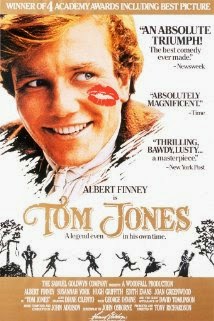
TOM JONES - 1963

Unfortunately, Tom Jones is not available on Netlfix. So I've elected to pass it over and continue moving on. Hopefully at some point down the road I'll have the means to watch it and add my riveting thoughts and insights to canon of those great critics of the past who have already weighed in on the matter.

Sunday, March 23, 2014

LAWRENCE OF ARABIA - 1962


I had never seen Lawrence of Arabia until viewing it for this blog, despite being well aware of this film ever since I was a kid. My grandma had a copy of it on VHS, spread across three videotapes, due to its mammoth length. Needless to say, as a kid I chose to watch Ninja Turtles and Pound Puppies instead. As for later on in life, I’m not quite sure why I never got around to watching Lawrence of Arabia. There’s been nothing but ebullient praise uttered on its magnificent behalf. Adjectives such as epic, masterpiece and stunning have all become permanent fixtures in hailing descriptions of this desert adventure. Given the fact that I haven’t watched it until now has resulted in a lot of built up expectation for me over the years that this film was going to be the cinematic equivalent of riding the lightening. After becoming familiar with David Lean’s previous Best Picture winning effort, Bridge on the River Kwai, I was expecting Lawrence of Arabia to be that much more of a thunder punch of awesomeness. 

So imagine my disappointment when the film turned out to be just OK for me. I know that sounds incredibly snotty to say, bitchy even. But it’s true, and I’m not going to deliver a bunch of canned praise that isn’t sincere and genuine just because everyone else seemingly loves this film. Actually, truth be told, Lawrence of Arabia’s first act had my complete and full attention. But as the film wore on, my interest in the story and lack of connection to the characters and their plight increasingly waned until my mind basically checked into the classy establishment known as the “I Couldn’t Give A Rat’s Ass” hotel. But I beg you, old sport, don’t misinterpret my sentiment to be a confession that I detested the work in its entirety; quite the contrary. There is a lot to admire about Lawrence of Arabia, and it is an unquestionable achievement. But if a film delivers the razzle dazzle on all of the senses save the heart, then it never truly delivers, which is the dilemma Lawrence and I encountered together. 

Directed by the terrific David Lean, Lawrence of Arabia is toplined by Alec Guinness, Jack Hawkins, Omar Sharif and the prodigiously talented Peter O’Toole. Incredibly, the role heralded O’Toole’s film debut, essentially making him an overnight sensation. The film also caused a sensation among Academy voters, who wrapped the film in Oscar glory with 10 nominations, and seven eventual victories, including Best Picture in 1962. In terms of Oscar trivia, Omar Sharif’s nomination for Best Supporting Actor marked the first acting nomination given to an actor from the Middle East (Sharif is from Egypt). Additionally, the film marked the first of eight acting nominations for Peter O’Toole, who, wickedly, was never awarded a competitive Oscar. Although, the Academy did their best to make amends for this travesty by presenting O’Toole with an Honorary Oscar in 2003.

Lawrence of Arabia follows an important chapter in the military career of T. E. Lawrence, an enigmatic misfit lieutenant in the British Army stationed in Cairo during WWI. Anxious to get out into the field, Lawrence is offered an assignment to go and assess the prospects of Prince Faisal in Arabia, and his campaign to put on his shit-kickers and revolt against the Turks. This assignment marks the beginning of Lawrence’s later success in boldly uniting the heretofore contentious tribes of Arabia in their struggle to finally oust the Turks from their land. 

Due to experiences in leading the guerilla campaign assaults on the Turks, Lawrence gradually becomes a changed man, after waging and suffering atrocities. He’s like the proverbial Jedi Knight who feels assured of his place on solid ground, only to lose his footing and stumble into the realm of the Dark Side. But what unnerves Lawrence the most is that he fearfully discovers that he isn’t repulsed by unchaining his darker impulses. In fact, he even relishes them to a degree. In the end, Lawrence is hailed a hero for leading the liberation of Arabia from Turkey. However, the situation’s resolution also signals the termination of Lawrence usefulness, and he is ordered to return home in a state of dejection.

As I hinted at before, Lawrence of Arabia has many striking features that make it difficult to refuse. The most salient component is the cinematography. Stuh-ning. All of the desert vistas and rippling sandscapes are latitudinous in scope and size. The scenes where Lawrence and his band cross the Nefad desert is like an issue of National Geographic magazine’s greatest desert hits come to life. I’ve never seen desert landscapes presented on film in such a domineering and crushingly beautiful fashion. It truly created such an uncommon and unfamiliar looking backdrop to the story that it produced the effect of being otherworldly, as though David Lean had transported his entire cast and crew to another planet. I’m conscious of the fact that it sounds like I’m over hyping the visual splendor of this film, old sport, but I assure you that is not possible. It’s a marvel and provides great merit to the film.

The other aspect pertaining to Lawrence of Arabia that ignited my senses was the film’s score, composed by the brilliant Maurice Jarre. I’ve loved so many of his other scores, such as Ghost and Doctor Zhivago, but in my estimation, Lawrence of Arabia places as the crown jewel of Jarre’s career. It’s exquisite and lush, with an elegant quality that swells in its sonic capabilities. It all felt like a cool drink of water to the senses, particularly during the sustained scenes in the desert. Thus far, I would rank it second only behind Max Steiner’s work in Gone with the Wind on the list of those most accomplished Best Picture scores. It adds so much emotion to the film, preventing it from stumbling during the portions lacking in humanity and depth.

But as I said earlier, a film can charm the senses, but if it fails in its effort to capture the heart, then it doesn’t truly succeed. I found this to be my dilemma with Lawrence of Arabia. It’s a great paradox: The film fired on all cylinders, yet failed to kindle an investment of feeling in the characters, particularly in the man himself: T.E. Lawrence. By the time the final credits unexpectedly roll, I felt as though I was meagerly any more attuned to understanding the character of Lawrence than when the film began. I get that he was an enigmatic character, I really do. But it seemed only thin strands of light filtered through to reveal his character, and in a film running nearly four hours long that is inexcusable. I felt as though the film hit all the right points in moving us through Lawrence’s adventure as it unfurled. But what of his disposition to join the tribes? The genesis to strike out into the desert to unite them? The origin of his short-lived streak of sadism? These questions and more rooted in the flesh of Lawrence’s character never really produce answers that can create any satisfactory dimension.

Clearly, Lawrence is a self-tortured man, but the complex parts working in concert to produce his drives is never fully brought to bear. One reason owing to this lack of illustration is that the film spends too much time pulled back, showcasing the story on a more macro level. How can an audience be expected to appreciate someone’s character when the story is more wrapped up in sprawling scenery, exploding trains and arguments with commanding officers? The simple answer is that they can’t. I’m convinced even the largest personalities can’t compete against such entertaining splendor that the film projects up there on screen, and T.E. Lawrence proves he isn’t up to the task, either. The irony is that Lawrence of Arabia is, to a certain degree, a character study, only except for the fact that no character is being fully studied. In the end, it isn’t sufficiently moving, which left me feeling somewhat like our hero, despondent in wondering what it was all for in the first place.

Favorite Line: In speaking to Lawrence of his work with the Arabs and whether the British are dealing openly and squarely with them, Mr. Dryden, his superior, tells him, “If we've been telling lies, you've been telling half-lies. A man who tells lies, like me, merely hides the truth. But a man who tells half-lies has forgotten where he put it.”